
Physical
Streaming
Download


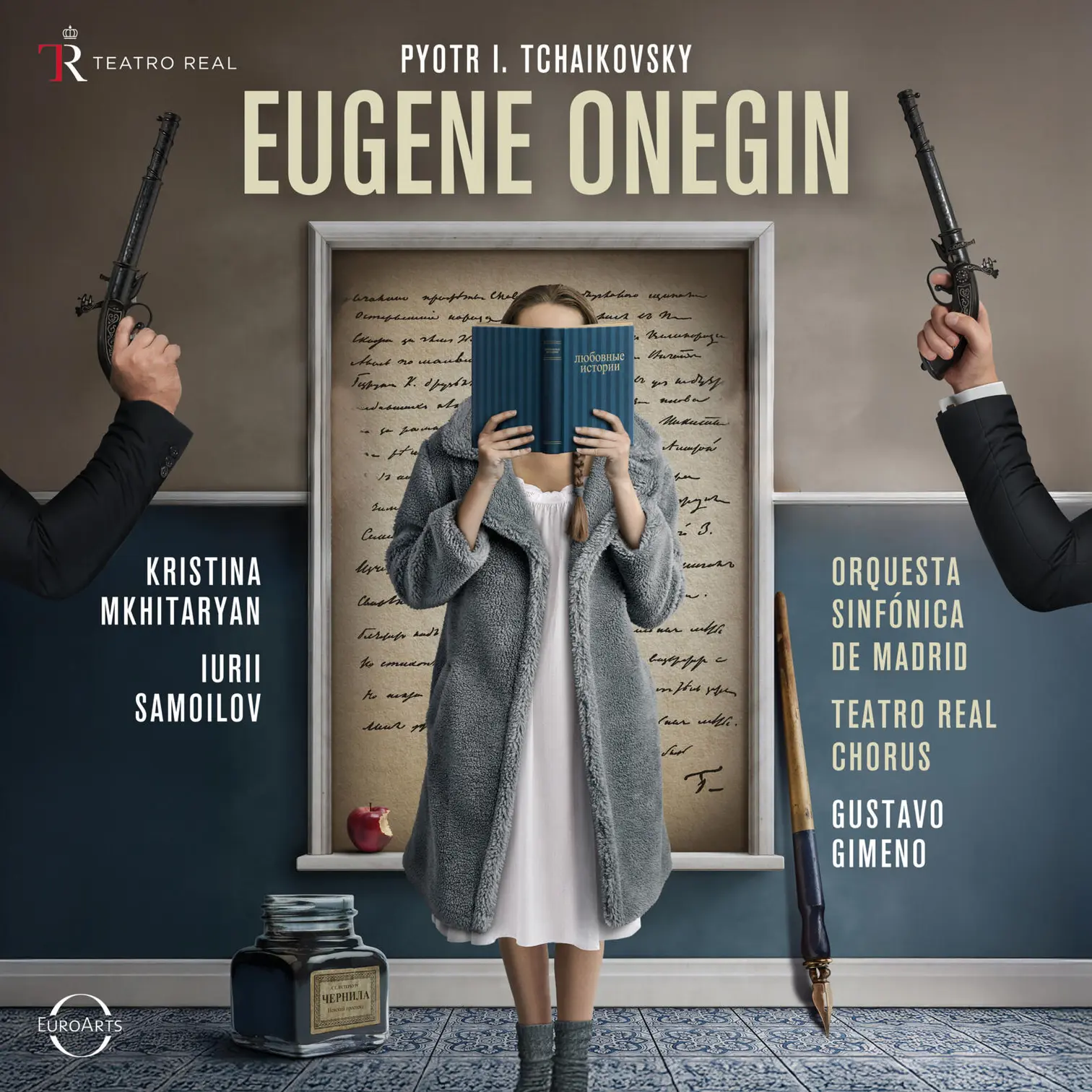
The Teatro Real’s recent staging of Tchaikovsky’s “Eugene Onegin” offers a profound and intimate exploration of love, regret, and honor, brought to life by a stellar cast.
Ukrainian baritone Iurii Samoilov delivers a convincing portrayal of Eugene Onegin, capturing the character’s evolution from detached arrogance to profound remorse. His performance is both powerful and subtle, effectively conveying Onegin’s complex emotional journey. Notably, Iurii Samoilov plays his Onegin with a distinctive touch—a single pearl earring—that adds a layer of enigmatic charm to the character. This subtle detail may also serve as a nuanced reference to Tchaikovsky’s own concealed homosexuality, adding depth to Onegin’s portrayal and inviting reflections on themes of hidden identity and unspoken desires.
Opposite him, Russian soprano Kristina Mkhitaryan shines as Tatiana Larina. Mkhitaryan’s expressive soprano and emotive acting bring depth to Tatiana’s character, making her internal struggles palpable. Her performance is so compelling that one might consider renaming the opera “Tatiana Larina” to reflect her central role. A standout moment is the letter-writing scene, which captures the audience’s heart; as Tatiana composes her fateful love letter, the applause that followed in the Teatro Real de Madrid was both spontaneous and prolonged—a testament to the scene’s emotional resonance and her great performance.
Ukrainian Tenor Bogdan Volkov portrays Lensky with sincerity. While Lensky, initially overshadowed by Onegin’s dominating presence, becomes all the more tragic and beautiful as his fate and death loom near. His performance becomes increasingly compelling as the narrative progresses, culminating in a poignant delivery of Lensky’s aria before the duel—a moment that foreshadows his tragic fate.
Conductor Gustavo Gimeno leads the Teatro Real Orchestra with both precision and passion, his expressive style adding depth to Tchaikovsky’s music. The unique layout of the Teatro Real allows the audience to clearly see Gimeno’s gestures and expression, making his connection with the audience more personal and visible. His attention to detail, from shifts in tempo to carefully shaped dynamics, brings out the emotional layers of the Russian opera. The brass section, in particular, plays a key role under his direction, adding intensity and weight to some of the opera’s most dramatic moments.
One of the most powerful scenes where Gimeno’s conducting stands out is the duel between Onegin and Lensky. The orchestra feels almost like an extension of the characters’ emotions, with sharp bursts from the brass and tense, pulsing strings that capture the rising tension between the former friends. Gimeno builds suspense, using sudden silences and surges of sound to mirror the characters’ inner turmoil. As the scene reaches its tragic conclusion the music swells with strong force, especially when Linsky turns the gun on himself.
German director Christof Loy presents a minimalist yet impactful staging. In this production of “Eugene Onegin,” every scene opens with a moment of silence, transforming the stage into a series of living paintings. Whether by deliberate design or serendipity, this staging choice successfully draws the audience’s focus to the unfolding drama. The production also features traditional Russian elements, with the chorus wearing classic costumes, including Babushkas (the Russian grandmothers), and engaging in lively celebrations. The minimalist staging, characterized by its simplicity and focus on the performers, allows for an exploration of dramatic action.
Overall, the Teatro Real’s “Eugene Onegin” is a blend of musical excellence and thoughtful staging. The production’s deliberate pacing, innovative interpretations from Pushkin’s book, and focus on character development provide a deeply engaging experience. In the end, “Eugene Onegin” is reduced to its simplest form: a story of a love that is ultimately rejected. Its simple, minimalist set lets the audience focus on the emotional depth of Tchaikovsky’s work and even reflect on his personal life.
Featured artists:
Orquesta Sinfónica de Madrid, Katarina Dalayman, Kristina Mkhitaryan, Victoria Karkacheva, Elena Zilio, Iurii Samoilov, Bogdan Volkov, Maxim Kuzmin-Karavaev, Frederic Jost, Juan Sancho, David Romero, Alexander González, Gustavo Gimeno, Teatro Real Chorus