
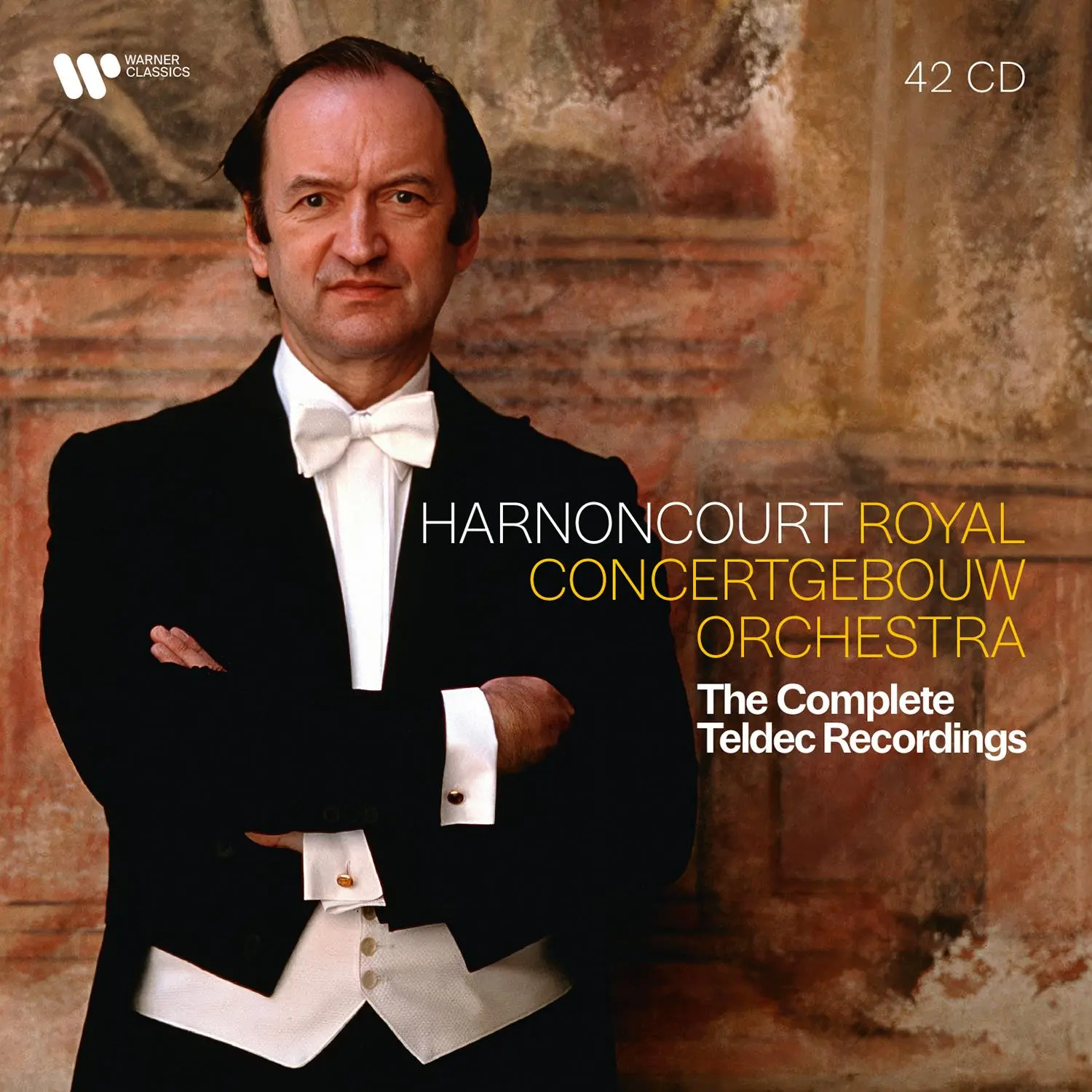
Royal Concertgebouw Orchestra - The Complete Teldec Recordings (42CD)
Royal Concertgebouw Orchestra, Nikolaus Harnoncourt
Físico


Nikolaus Harnoncourt was born in 1929 in Berlin into a noble family. He grew up in Graz, Austria and trained as a cellist in Vienna, also playing the viola da gamba. He spent most of the 1950s and 60s as a member of the Vienna Symphony Orchestra, but rebelled against the practice of taking a Romantic approach to music from every era and rejected the idea of the conductor as autocrat. When he became a conductor he preferred to treat the orchestral musicians as colleagues.
In the early 1950s Harnoncourt and his violinist wife, Alice Hoffelner, founded the Concentus Musicus Wien, the first professional orchestra in Europe to play on period instruments and dedicated to music of the pre-Romantic era. In 1954 he had written of the need “to hear and perform [Bach’s masterpieces] as if they had never been interpreted before”.
From the 1970s onwards Harnoncourt developed relationships with a number of major modern-instrument orchestras, including the Wiener Philharmoniker, Vienna Symphony, Royal Concertgebouw, Berliner Philharmoniker and Chamber Orchestra of Europe.
He took a scholarly approach to the score, no matter what the era of its genesis, searching out original manuscripts and orchestral parts to gain a deep understanding of the composer’s intentions and the performing style of the composer’s time. As Sir Nicholas Kenyon wrote in Gramophone after Harnoncourt’s death: “He wanted to explore why composers made their music sound as it did, to understand what their intentions were, to react to the instruments they used and to their sonorities, and to see how they could best be created anew in our time. He did not believe in ‘authenticity’ as such, and never used the word. Instead he questioned ‘tradition’ as laziness [as] Mahler had before him.”
Harnoncourt was deeply engaged with the world of centuries past – perhaps to get a little closer to the unanswerable question of how listeners of those times might have experienced the works of the great masters. He studied sources from those eras to learn how musicians had actually played. That historical context, for him, gave the music its colour. His unique gift was to translate that knowledge into the sound and performance practice of a modern symphony orchestra.
Nikolaus Harnoncourt’s relationship with the Royal Concertgebouw Orchestra was one of the most transformative partnerships in modern orchestral history, lasting 38 years and totalling 276 concerts. Beginning in 1975 (with Bach’s St. John Passion), the Austrian conductor brought his radical “Historically Informed Performance” (HIP) principles to one of the world’s most traditional romantic orchestras. This collaboration challenged the musicians to rethink their phrasing, articulation, and use of vibrato, ultimately bridging the gap between old-world symphonic sound and baroque authenticity.
What made this partnership unique was the mutual respect between the maestro and the ensemble. While many traditional orchestras initially resisted Harnoncourt’s strict adherence to historical scores, the Concertgebouw musicians embraced his intellectual rigor. Over several decades, they developed a distinctive “Amsterdam style” of performing the First Viennese School – Mozart, Haydn, and Beethoven – that combined the orchestra’s legendary warmth with Harnoncourt’s sharp, dramatic energy.
The recorded legacy of this collaboration remains a cornerstone of the classical catalog. Their famous cycles of Mozart and Haydn symphonies were highly acclaimed, as was their profound interpretation of Schubert’s complete symphonic works, which continue to be benchmarks for critics and collectors alike. The box also includes the famous Mozart/Da Ponte trilogy (Don Giovanni, Le nozze di Figaro and Così fan tutte), starring Thomas Hampson, works by Bruckner, Johann Strauss and Brahms, as well as four albums by Dvořák (his major symphonies and his piano concerto).
Would you prefer to visit our website in English?